Showing posts with label water testing. Show all posts

Saturday, March 17, 2012

Is Your Refractometer Calibrated?

I've had some odd happenings with some coral, and in the process of narrowing down the culprit, I figured it was time to give the ol' refractometer some attention. I calibrate it every so often with RO/DI water, but after reading a few online articles, I was convinced that calibration with RO/DI water wasn't providing accurate results.

There are recipes to make a calibration solution at home... and in retrospect, that would have made a great DIY article... but I went the easier, more accurate route and purchased some American Marine Pinpoint Salinity Calibration Fluid. The calibration solution will allow you to calibrate to a higher point on the scale, which provides a better level of accuracy for the ranges we were commonly testing in.

The calibration solution will allow you to dial in salinity to 35 ppt, which is about 1.026 sg. To ensure better accuracy, I set up a "calibration station". I put warm water into a cup (measuring cup) and dropped in my handy dandy cooking thermometer (which I have calibrated recently). I waited until the temperature was about 80 degrees and dropped the bottle of calibration solution in there. When the temperature of the solution was at 78, I took a sample with a syringe and dropped a few drops onto the glass testing surface of the refractometer. (It's starting to feel like high school chemistry all over again). I closed the cover plate, and took a visual reading. 

The reading was right on: 35ppt. "Wow," I thought, "that was uneventful." Indeed it was. I rinsed the refractometer with some clean RO/DI water and tried again. To attain a sense of satisfaction, I moved the calibration screw with a small screwdriver. I moved it up, I moved it down, and then I carefully dialed it back in. Rinsed it, and tried with some more solution (why not, I have a huge bottle of it). Bam. It was set. I tired with some RO/DI. Bam, set.

While I didn't have any "A-ha" moment with testing, it was certainly good to know my refractometer was calibrated accurately. A little insurance goes a long ways, and I now can calibrate my refractometer with a level of accuracy going forward.

Until next time...

Sunday, November 20, 2011

Testing: You can do it!!

Water testing is easy and really only takes a few moments. A basic test kit isn't out of reach for any hobbyist, and you'll be surprised at the price of some entry level kits.

I use the API tests. Yeah, yeah, yeah... these tests get a bad rap by many hobbyists. Personally, I think they're great. I'm not looking for lab grade scientific testing... I barely passed chemistry in high school; I'll leave the hardcore testing for the chemists. What I want is an easy to use and affordable test kit. Yeah, the more expensive kits can be a little more precise, but I'm looking for ball park figures. I know my tank and I keep up with water changes. Why kill myself over a fraction of a fraction of a percentage?

Don't get me wrong, there are some really nice liquid test kits, and I'm a big fan of the Hannah Checkers; both are still relatively easy to use and can provide the accuracy that puts some hobbyists at ease. For simplicity and budget's sake, you can't go wrong with the API Salwater and API Reef Master Test Kits.

I've tested today using my API test kits and a Salifert Magnesium Test kit. I am happy with the levels as I had lower Calcium recently, and I'm trying to keep my Alkalinity low due to the use of biopellets on my system. I've posted the test results below:

Ca: 440
Alk: 8 dkh
Mag: 1500
pH: 8.2
Nitrate: 0 ppm

Levels look good, biopellets seem to be working well... Photos soon!

Thursday, March 24, 2011

It's RO Wednesday!

Payday comes but twice a month, and what better way to celebrate pay day than buying gear for the tank! I needed a new color changing DI cartridge, but why stop there?

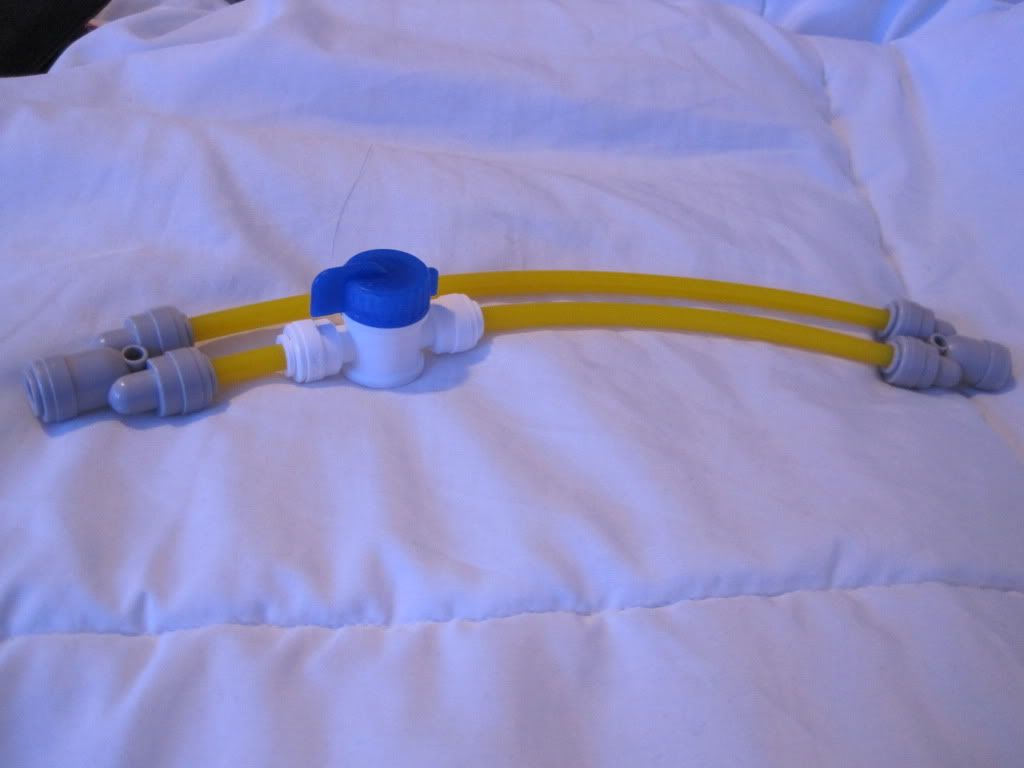
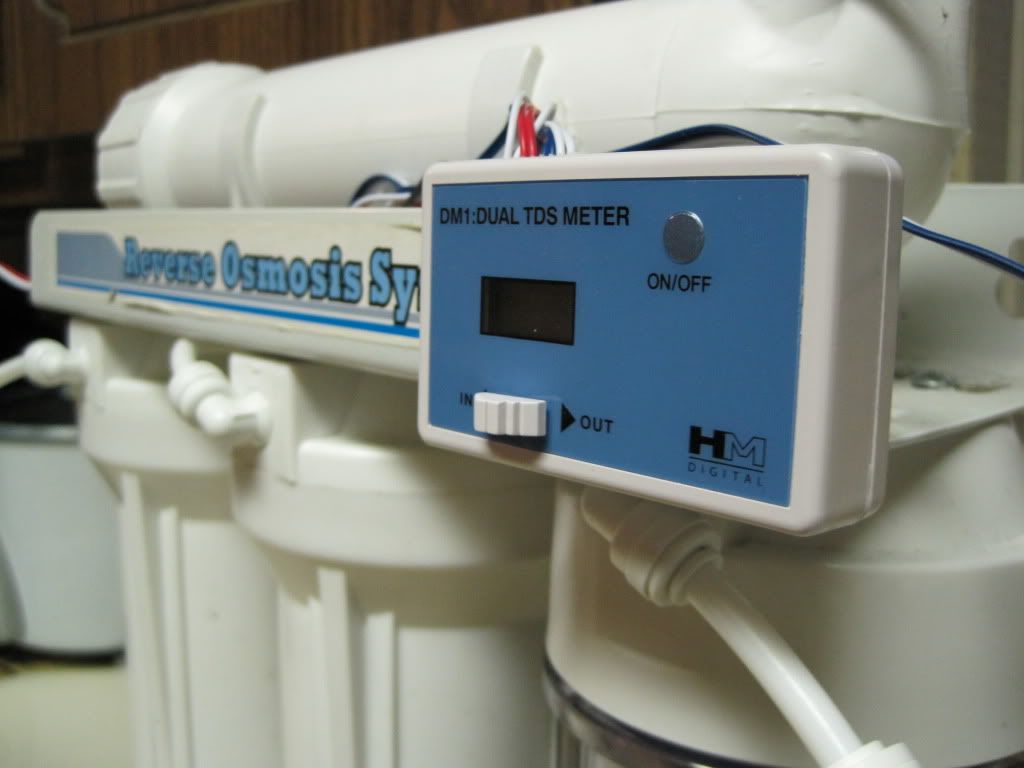
Flush valveI bought a TDS meter (total dissolved solid) and a flush valve kit. The TDS meter will allow me to monitor the total dissolved solids of the incoming city water and my final product water. The flush valve kit is a simple device that allows me to bypass the flow restrictor, allowing water to flow faster through the TFC membrane. Flushing your TFC membrane will help extend the life, so hopefully I can get 3 years out of the membrane. Time (and my TDS meter) will tell.

TDS meterAfter the install, the TDS is reading around 460 tds going into the RO/DI unit (good ol' city water) and reading 0 tds coming out (like mountain spring, but better). Allow me to jump on the bandwagon: "Winning"... Yeah, I said it. It's my blog: I do what I want!!!

Next update: A new fish, coral, and a clam are currently in route for delivery tomorrow. I'll post pictures of the new arrivals after they are all here!