Showing posts with label equipment. Show all posts

Thursday, November 21, 2013

Ecotech Marine Coral Fragging Tool Kit

Ecotech Marine Coral Fragging Tool Kit
Just in time for your holiday wishlist, the Ecotech Marine Coral Fragging Tool Kit is here...

The first thing that I have seen posted from hobbyists on forums and blogs about this item is something along the lines of, "$99?! I could buy all of these items separately for $X... [etc, etc, etc...]." Yes, you certainly COULD buy some inexpensive items and throw a kit together. Let's be frank (honest)- If you were already thinking that, then this product is probably not for you. Just as if you look at the Ecotech Marine Radion and say, "I could just build my own... [etc, etc, etc]"... then those lights are not for you either. It's okay, it happens.

Ecotech products command a premium and are not for everyone. That said, Ecotech is a growing business that has a strong and loyal customer following. This product is for the loyal fans, looking for quality and style. This Fragging Tool Kit is for the guy that has everything. The guy who likes high-end lighting, who sees value in Ecotech Lights and Pumps- the guy who takes so much pride in his aquarium, that he wants to have a great tool kit to propagate his coral. For that guy, he can now frag his coral in style.

(More information and photographs after the break...)

Saturday, August 17, 2013

Feelin' Hot! Hot! Hot!

Summer is well in full swing now, and if you haven't already been battling heat, you will. Battling the heat can be difficult, and often times we must resort to expensive or drastic measures.

So what causes the temperature in your aquarium to rise? Well in the warmer times of the year (usually Summer), the ambient temperature will certainly be the main cause. The warmer weather can shoot temperatures up into the 80's or even 90's, and this can be extremely stressful (or deadly) for your reef tank. There are also other factors that contribute heat including pumps, power heads, and lighting.

So what can we do to combat this? Well, there are many angles to try. No one way is necessarily better than the other, and you may wish to combine multiple methods. (Read more after the jump)...

Saturday, May 4, 2013

Skimmer Overflowing? Try the Rem's Reef Method!!

Collection cup fitted with ball valve.
I had a mild but persistent Cyano (red slime) problem a few months back. While water changes kept the problem somewhat at bay, there were still a few spots where the red slime was clinging on. I had some cyano remover left over from a previous treatment, so I figured I would give it a try again.

Everything went well; the cyano went away, nothing perished. Good times. I did my 20% water change, replaced carbon, and in kicked on the skimmer. The skimmer overflowed. The annoying white clear foam rose through the skimmer's collection cup like a volcano... Not a real one, more like a papermache volcano from a science fair... but sill fiercely annoying! I removed the collection cup to let it do its thing. It overflowed.

I added more carbon and did another water change. It. Well... Overflowed. I let it run for a day and night. Guess what? It just kept overflowing. BLAST! I've used the product before and it usually got better on its own. This time- my skimmer continued to overflow.

Wednesday, April 10, 2013

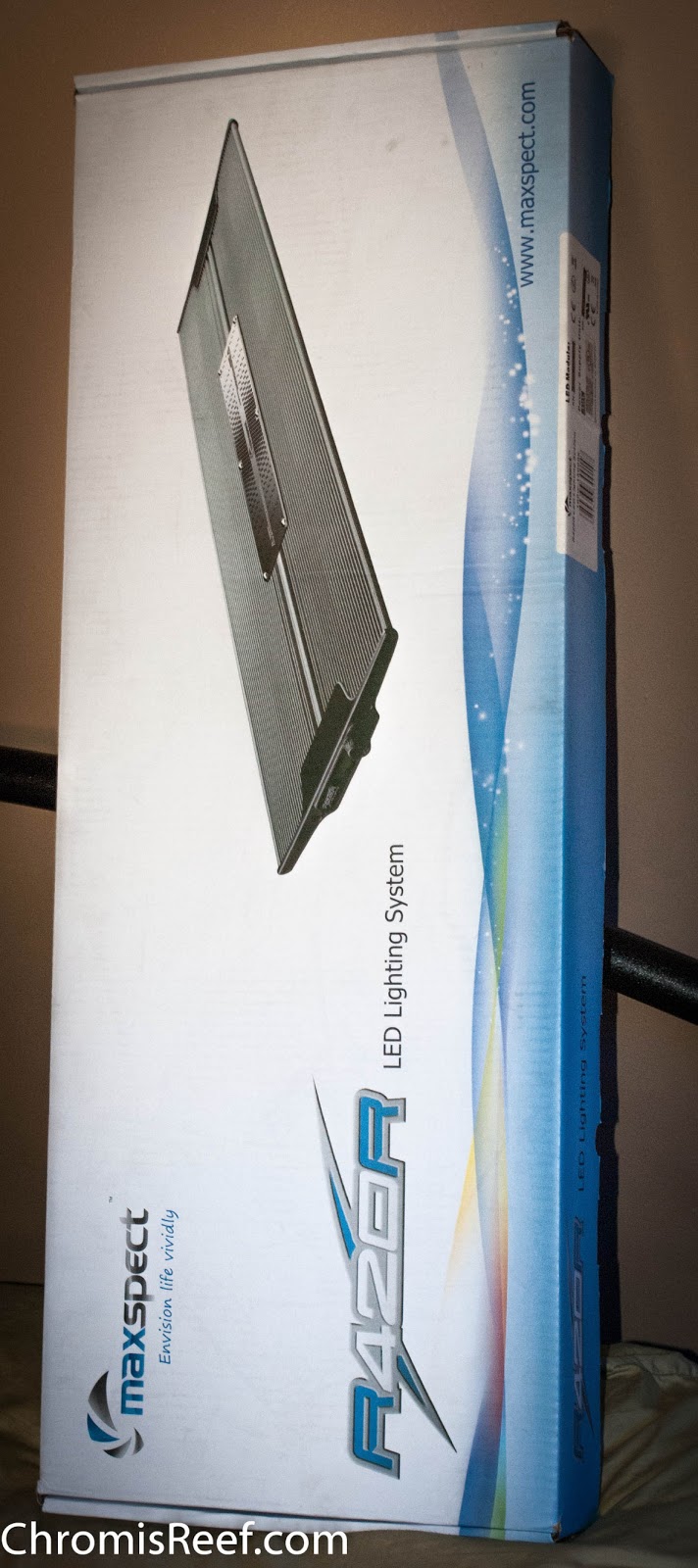
Product Review: Maxspect Razor

I posted a "sneak peak" of the Maxspect Razor when it was first released last year which proved to be quite the popular article (Sneak Peak - Maxspect Razor R420R LED!). Months later, I've been toying with the idea of replacing my T5 fixture with an LED fixture. When I was offered the opportunity to put the Maxspect Razor on my aquarium to see if I liked it, I jumped at it.
The box
I've now created a second review after having my hands on this for a while... More pictures after the jump.

Thursday, March 28, 2013

Product Review: AquaMaxx EcoMaxx 100 (EM100) Protein Skimmer

Sometimes being an early adapter of a product can scare some people off, but not this reef nerd. "AquaMaxx has a new skimmer design with a new pump?! Count me in!"

(As you can tell by my video, it's difficult to take good images of anything in my sump. Sorry.)

A handful of my fellow reefing buddies (reef nerds) have been running the AquaMaxx AM series in sump protein skimmers, and we have a HOB-1 (hang on back) on the 28 gallon JBJ Nano Cube. I had heard great things about these AquaMaxx protein skimmers and seen great results from fellow reef nerds. When I was setting up my system and purchasing my first in-sump skimmer, I hit a snag: I only had 23" of height to work with in my tank stand. The coveted AquaMaxx skimmer I wanted would have to wait for another day.

Editorial note: I was reluctant to post my review for this skimmer as I was too excited/lazy to document the assembly and install process. The skimmer has now been in my sump for over 6 months, and I have yet to take any photos of the skimmer for my review. That said, I did imbed a quick YouTube video above so see it after it had been in my system for a month or so, and I'll update this post in the future if I take some photos.

(Follow the link to read more...)

Saturday, March 16, 2013

Photos of the Reef

The rock work as of today (3.16.13)
After a water change this morning, I figured I should take a few photos of the reef de Chromie.

I've moved stuff around and removed a couple of corals, but most of the coral are still the same as before. Some coral have grown better than others, but many have not really grown as well as I would like. I have a problem of either breaking the coral before they grow or moving them too much.


(More images after the jump!)

Monday, March 11, 2013

Interesting Reef Finds at PetSmart?!

"Grabber Tool"
I know PetSmart has the reputation of being a "newb" spot... and with reason... However, we all know that any "advanced" hobbyist going to PetSmart for aquarium advice is probably not as "advanced" as they claim to be online (internet trolls), and I've been to plenty of Mom-and-Pop local fish stores (LFS) that dispensed the worst advice possible. I have a general distrust of many LFS as often they have incentives to sell you incompatible livestock and supplies you don't need. That's just me, and I know there are MANY great LFS out there (when you find a good one, stick with them and keep them in business!)... That said, I go to PetSmart primarily for dog supplies. I then tend to drift into my old stomping grounds, the fish department.

Saturday, March 9, 2013

Back to Basics: Mixing Saltwater...

There's probably about a million posts about this already... but here's post number 1,000,001!

Mixing saltwater: it's easy and convenient. It's often even more economical than buying it, especially when you have a large aquarium.

I hate to say it, but it's been over two years since I bought premixed saltwater. It was a chore to drive to my local store and then come home with mixed salt, only to then begin the water change. The chore of going to get the water was my old excuse for not doing frequent enough water changes. (I have now developed more complex excuses... Did you hear about the time my RODI unit was sabotaged by a band of of rouge agents bent on world domination through the proliferation of cyanobacteria and destruction of coral reefs?!) Well the moral of the story (the purchasing of water not the rouge agent thing) was that its a mission to go get water, especially if buying large quantities of saltwater.

Besides the chore factor, the costs can add up quickly when you're paying someone else to mix water for you. While I can concede that it's less equipment and cleanup to just bring a couple of containers for fill up, I would not want to have to buy 30 gallons per week to change water on a 300 gallon system.

There is also a final consideration: emergencies. It's easier to always have a little saltwater on hand when you can mix it yourself. This is good in case something unexpected happens- and "it" will happen. Having water on hand might be the factor that saves your reef from failure.

Friday, February 22, 2013

Sneak Peak: Innovative Marine MiniMax Reactor

I got a sneak peak at the latest gadget from Innovative Marine, the Innovative Marine MiniMax All-In-One Media Reactor. They are quite... Innovative.
MiniMax Reactor w/ packaging.
ReefBuilders released news of the item early this week, and I was certainly impressed by what I saw. Well, today I got to see this new filter in person. In the images, the reactor was installed on a JBJ RL 14 Gallon aquarium for display purposes only. It was not installed into a live reef system.

The reactor was filled with biopellets (a.k.a. bio plastics). This is a great media to test the reactor with as it's heavy and needs to tumble. If the reactor can easily tumble bioplastics, it should have no problem with carbon or GFO (granular feric oxide).

(More details and images after the jump...)

Thursday, December 13, 2012

Sneak Peak: JBJ Cubey All-in-one Biotope

The JBJ Cubey is best described as "cute". I mean look at it! It's petite and functional, and has a real LED system in it. The item has yet to hit shelves, but is expect to be released for pre-order on retailer's sites very soon.
The JBJ Cubey - Inside is the filter sponge and media basket
I saw the "little guy" at Reef-a-palooza 2012. I saw the white version which was certainly nice, but I was excited to see the black color version today. I definitely like the look. Check out my photos after the jump.

*Update (12/28/2012): Item now available at Marine Depot: JBJ Cubey 3 Gallon Pico LED Aquarium. Available in black and white.

Friday, November 2, 2012

AquaticLife Impresses Reefers with new Expert Series LED light

I hate to brag (no really, I do), but I got some hands on experience with the AquaticLife Expert Series LED system today. I can honestly say, this reefer was impressed.
Expert Series LED (image credit: AquaticLife.com)
AquaticLife makes some great light fixtures. They stood out among other light manufacturers in the industry by producing high quality, user friendly compact fluorescent and T5 fixtures. They started entering the LED market about a year ago with the Expandable LED fixtures, and followed up with some Single Watt LED reef fixtures. Then the introduced a new "Expert Series" led light.

I will be honest. When I first saw the Expert Series light online, it didn't tickle my fancy (so to speak). It looked like a plain, plastic box (looked like): nothing too flashy. Then I went to the Reef-a-palooza show, and saw the unit in person at the AquaticLife and Marine Depot booths. I got to touch it and hold it; my impression quickly changed. It was solid. It was metal. It was sleek. I needed to learn more about this light.

More after the link...

Friday, September 14, 2012

VIDEO: AquaMaxx EcoMaxx 100

Here's a short video I've been meaning to post since the first day I started running biopellets. You can see the Hydra Biopellet Reactor and my new AquaMaxx EcoMaxx EM100 In-Sump Protein Skimmer. Skimmer cup needed some cleaning, but you can see the dark skim it's removed.


The noise in the video is NOT the skimmer, it's the biopellets and pump. The skimmer is essentially silent! Full review coming soon!

Biopellet Progress

We're almost a month into Project Biopellet - Take II (name still tentative). For the first two weeks, I added 1/4 cups of Biopellets weekly. For the first two weeks, I also added Two Little Fishies Bioactiv8 on a daily basis. I would turn off the return pump for a few minutes and add the bacterial innoculant directly into the sump chamber where the biopellet reactor is located. I would then leave my protein skimmer off for an hour after adding this.

So far, no problems. I have seen a huge reduction in cyano bacteria growth that was present before I started the biopellet system again. There has also been a reduction in the growth of hair algae, though some still exists. I will continue to remove either cyano or algae as I see it during water changes. Coral look healthy. I'm seeing polyp extension and no loss of color. 

Wednesday, August 22, 2012

Trying Biopellets... Again.

My previous experience with biopellets wasn't bad. I removed the system to see if the low nutrient environment was causing some issues with my soft coral. I had some zoanthids that were closed up and were dying off. I removed the system, and figured out there were a few unrelated issues (including a hitch hiking crab) that were at fault. Oops.

(Read more after the jump!)

Thursday, July 12, 2012

Sneak Peak - Maxspect Razor R420R LED!

I got to take a look at the newest LED fixture from Maxspect. The Maxspect Razor R420R LED Light Fixture is an impressive lady. Sleek, thin, attractive. Can be mounted on the aquarium using the included mounting legs, hung from the ceiling or from hanging arms, or using the Maxspect mounting system. It's quite versatile.

(More information and images after the jump!)

Friday, March 30, 2012

Reefkeeper Elite

Look what I got. RKE head unit to upgrade my RKL system. More info to follow.

Saturday, March 17, 2012

Is Your Refractometer Calibrated?

I've had some odd happenings with some coral, and in the process of narrowing down the culprit, I figured it was time to give the ol' refractometer some attention. I calibrate it every so often with RO/DI water, but after reading a few online articles, I was convinced that calibration with RO/DI water wasn't providing accurate results.

There are recipes to make a calibration solution at home... and in retrospect, that would have made a great DIY article... but I went the easier, more accurate route and purchased some American Marine Pinpoint Salinity Calibration Fluid. The calibration solution will allow you to calibrate to a higher point on the scale, which provides a better level of accuracy for the ranges we were commonly testing in.

The calibration solution will allow you to dial in salinity to 35 ppt, which is about 1.026 sg. To ensure better accuracy, I set up a "calibration station". I put warm water into a cup (measuring cup) and dropped in my handy dandy cooking thermometer (which I have calibrated recently). I waited until the temperature was about 80 degrees and dropped the bottle of calibration solution in there. When the temperature of the solution was at 78, I took a sample with a syringe and dropped a few drops onto the glass testing surface of the refractometer. (It's starting to feel like high school chemistry all over again). I closed the cover plate, and took a visual reading. 

The reading was right on: 35ppt. "Wow," I thought, "that was uneventful." Indeed it was. I rinsed the refractometer with some clean RO/DI water and tried again. To attain a sense of satisfaction, I moved the calibration screw with a small screwdriver. I moved it up, I moved it down, and then I carefully dialed it back in. Rinsed it, and tried with some more solution (why not, I have a huge bottle of it). Bam. It was set. I tired with some RO/DI. Bam, set.

While I didn't have any "A-ha" moment with testing, it was certainly good to know my refractometer was calibrated accurately. A little insurance goes a long ways, and I now can calibrate my refractometer with a level of accuracy going forward.

Until next time...

Tuesday, February 28, 2012

*ReefKeeper Alarm Triggered*

Well my aquarium has been giving me grief, off and on, for some time now. Between float switches sticking, temperature fluctuations, and faulty/clogged Aqualifter dosing pumps I've had my aquarium overflow already. After the overflow, I added a float switch to my aquarium that will 1) trigger an alarm and 2) shut off the return pump.

Today while in class, I was notified by my ReefKeeper Lite by email that one of my float switches had activated, triggering an alarm. This float switch is located in my display, and is only activated when the water level gets dangerously high.

Upon notification, I was able to completely shut down the return pump and my ATO pump. I was also lucky enough to have someone close by to check on the tank. Sure enough, the tank had filled up and my sump was full to the rim, but no water had spilled out on the floor; a disaster was averted! Floors were dry, fish were safe, and I could breathe a sigh of relief.

While I'm going to have to do some investigation and tinkering to see what I can do to prevent this issue from happening again, I was lucky that my ReefKeeper emailed me. I didn't have to leave class, and I didn't have to worry all night about what was happening. it also prevented I'd come home to in 9 hours had I not been able to catch this.

While aquarium controllers aren't necessary for every tank, I'd have to say that today my ReefKeeper earned its spot as the best (and coolest) gadget on my aquarium.

Thursday, February 2, 2012

My Experience with Biopellets

AquaMaxx BioMaxx Plus BioPellets
Organic carbon dosing has proven to be an effective method for reducing and controlling nitrates and phosphates in a reef aquarium. One of the latest methods to hit the reef scene is the use of solid polymers, often referred to "biopellets" or "bioplastics". These pellets provide a carbon source and home for bacteria to colonize. These bacteria consume this carbon source and also take in nitrates and phosphates, reducing and removing these nutrients from the water. The bacteria are mostly removed by protein skimming, but a small amount are consumed as food in the aquarium. There's so much mixed information and for as many positive experiences, there seems to be as many negative experiences.

Well, there are many aspects to this type of system, and before implementing this method on YOUR system, there's a lot you should look into. While I have had a positive experience with bio pellets, they are by no means a miracle tool; they won't eliminate the need for water changes and they will not magically fix months of neglect. Remember, nothing good happens in a reef tank overnight. With that said, let me share my experience with the product.

I introduced the biopellet system to my aquarium in August of last year (2011) (You can read a bit about the installation from a previous article, "Aquarium Update" from August). I used AquaMaxx Biomaxx Pellets, and put them into a Two Little Fishies Phosban Reactor 150. I removed the two foam sponges, and purchased and installed a set of screens to prevent the pellets from escaping the reactor. There is a set amount of media to add for your system. Look it up, do some conversions, and remember that number. Got it? Good.
TLF Phosban Reactor 150 w/ Biopellets
For simplicity and round numbers, we're going to say that your system requires 1 cup of biopellets. You will want to add this final amount to your reactor of the period of several weeks. What I would recommend is to start the reactor with 1/4 cup (or 25% of the total amount you need), and add another 1/4 cup about a week later, and do this for the next 2 weeks until the reactor is full. This provides a month for the reactor to slowly take form on your system. During this time, you will want to start inoculating your tank (and the reactor) with a bacterial additive; I used Brightwell's Microbacter 7. You should do this every day for 2 weeks, and then add a maintenance dose about once every two weeks.

The pellets require a good amount of flow. I would suggest somewhere along the line of 350 gph. While a Maxi-Jet 1200 was previously recommended, I would suggest stepping up to a larger pump (I'm currently using a Mag-Drive 3.5 (offers 350 gph of flow). It's easier to dial back the flow with a ball valve than to deal with not enough flow. Low flow will cause the pellets to clump, either leaving the reactor ineffective or possibly causing problems for your aquarium.

In fact, anecdotal evidence I've come across online shows that control of the flow of the pellets AND flow of the water into the reactor may be key to this process. I would suggest taking a look at the two-part video series from LA Fish Guys. (Be warned, the videos are a little long). I found the information discussed to be informative and provides some valid points in regards to the current use of bioplastics and the reactors we are currently utilizing. The control of the flow of water from the aquarium and the tumbling of the pellets were not related; this is something most current reactors are not taking into consideration. The theory that the tumbling of pellets causes the reduction of waste, and more tumble reduces the reaction further is interesting and something I want to learn more about. You can view the videos at the links below.
Part 1: LA Fishguys, Bio Pellets, Episode 107 pt1
Part 2: LA Fishguys, Bio Pellets, Episode 107 pt2

The pellets themselves are not a disposable media that needs to be changed. You will replenish your pellets about once every six months on average. You will simply add more pellets to the existing pellets in the reactor. One helpful tip would be to mark the level of pellets on the side of the reactor when the flow is off. When your pellets are below this level, you can top it off to this line. You can mark it with tape, a marker, whatever.

Feeding your tank rather heavily seems to also be an important aspect to this system. I noticed that with my normal feeding regimen, my corals were not growing and my Zoas seemed to be shrinking. The bioplastics seem to rob the system of nutrients, and drop the levels so low that the coral can starve. To help combat this, you should feed a hefty amount of food to your fish and coral daily. I recently started adding liquid foods to the tank daily in addition to prepared fish foods and frozen foods. This seems to be doing the trick. My coral seem to be growing again.
Low nitrates
Finally, your dosing regiment seems to be somewhat important for use on a biopellet system. One common recommendation is to keep Alkalinity low, at around 8 dkh. All other levels should be maintained at normal acceptable levels. I have also been adding an amino acid supplement, a trace element supplement, and Lugol's solution. While there is no evidence that MY dosing system is doing anything for the biopellet system, it doesn't hurt, and so far my tank is doing well. Keep in mind, that while nitrates are reduced, you still want to preform regular water changes to help replenish trace elements.

Versus manually dosing your tank daily with a liquid carbon source, biopellets provide an alternative system that is supposed to provide many of the same benefits as the liquid systems. Is it better or anything more than snake oil? Well, to be honest, I can't really say. This is just what has worked for me and a many others who share similar stories. Research is lacking to explain exactly why biopellets are providing such a variable response. There isn't a whole lot of information available as to the who's and whats of why it works. With this method, we're at the mercy of trial and error- something I know I'm comfortable with, but understand that the guy running a 300 gallon SPS dominated tank he's had running nicely for 3 years may not want to mess with. This is KEY to why you have to really balance this approach out and decide whether this is right for your system. If it doesn't work out, it can cause problems for your tank if you remove the system too quickly without weaning it off.

If you're thinking of starting this type of system, I urge you to do your research and be willing to give it time. This is not an immediate cure for high nitrate and phosphate levels, and it is not a replacement for regular maintenance and water changes. I've included some bioplastics resources I found useful below.

Recommended Resources:
Until next time...

**Updates & Related Articles: (links add October 2013).


Thursday, January 19, 2012

Heater Off!

Well the power went out briefly on Monday, and somehow my heater was turned off. All other devices were fine, except the heater. Unfortunately for my coral and fishes, I didn't realize the aquarium was so cold until today. When I noticed the problem, it was at 69 degrees. In fact, I only thought to check the temperature after I put my hand in the tank to target feed my coral.


After checking the graph of the temperature, it looks like there is only a couple of days of data showing, indicating the power loss we briefly experienced on Monday. Going forward, I think I'll change the default status of the heater to "ON", and I'll make sure to check the temperature more often. While there is no loss yet, my Maxi-mini Anemone and my Torch Coral are looking unhappy. I'll keep an eye on this closely.